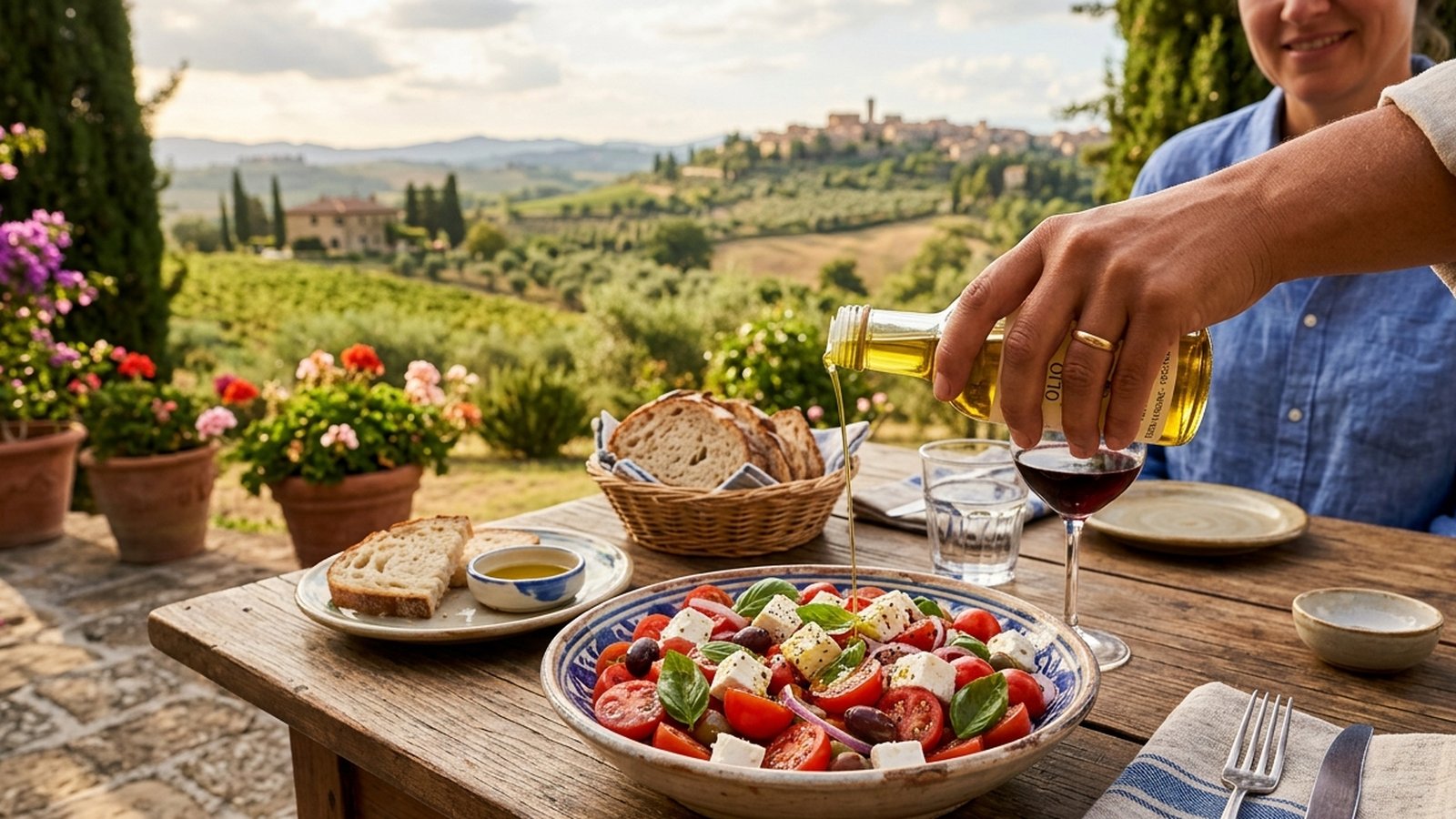
The PREDIMED trial — a five-year, 7,447-person randomised controlled trial published in the New England Journal of Medicine — showed a 30% reduction in major cardiovascular events from a single dietary pattern.
💡 Why this matters
The Mediterranean pattern emphasises olive oil, vegetables, fish, legumes, nuts, and whole grains. It is the most-studied long-term eating pattern in the world and consistently shows the strongest cardiovascular and longevity outcomes.
What the diet actually is
Not a single recipe — a constellation of food choices common to traditional southern European cuisine:
- Vegetables and fruit at every meal
- Extra-virgin olive oil as primary fat
- Fish 2+ times per week
- Legumes several times per week
- Nuts and seeds daily, modest portions
- Whole grains over refined
- Modest dairy, mostly fermented
- Sparing red meat and added sugar
The PREDIMED trial
7,447 people aged 55–80 at high cardiovascular risk randomised to Mediterranean + olive oil, Mediterranean + nuts, or low-fat control. After 4.8 years, the Mediterranean groups showed a 30% reduction in major cardiovascular events (heart attack, stroke, cardiovascular death). The trial was stopped early for ethical reasons (Estruch et al., 2018).
Beyond cardiovascular
Subsequent analyses link the Mediterranean pattern to lower risk of type 2 diabetes, cognitive decline, several cancers, and all-cause mortality (Dinu et al., 2018).
Adapting it to a Canadian kitchen
You don't have to live on the Med coast. Use olive oil for cooking and finishing. Eat fish twice a week (frozen Atlantic mackerel and salmon are excellent). Build a default plate: half vegetables, palm of protein, fist of whole grain or legume, thumb of olive oil. Snack on nuts, fruit, yogurt. Water as the default beverage.
Why it works long-term
The strongest predictor of dietary success is adherence, not specific macros (Dansinger et al., 2005). The Mediterranean pattern wins partly because it is satisfying, varied, and culturally adaptable.
Among persons at high cardiovascular risk, a Mediterranean diet supplemented with extra-virgin olive oil or nuts resulted in a lower incidence of major cardiovascular events than a low-fat diet.Direct conclusion of the PREDIMED RCT. Source: Estruch et al. (2018), NEJM.
By the numbers

Olive oil is the centerpiece, not a garnish. Mediterranean populations consume 30–50 mL daily.
References
- Estruch, R., Ros, E., Salas-Salvadó, J., et al. (2018). PREDIMED. NEJM, 378, e34. View source →
- Dinu, M., et al. (2018). Mediterranean diet and multiple health outcomes: an umbrella review. BMJ, 362, k2173. View source →
- Dansinger, M. L., et al. (2005). Comparison of Atkins, Ornish, Weight Watchers, and Zone diets. JAMA, 293(1), 43–53. View source →