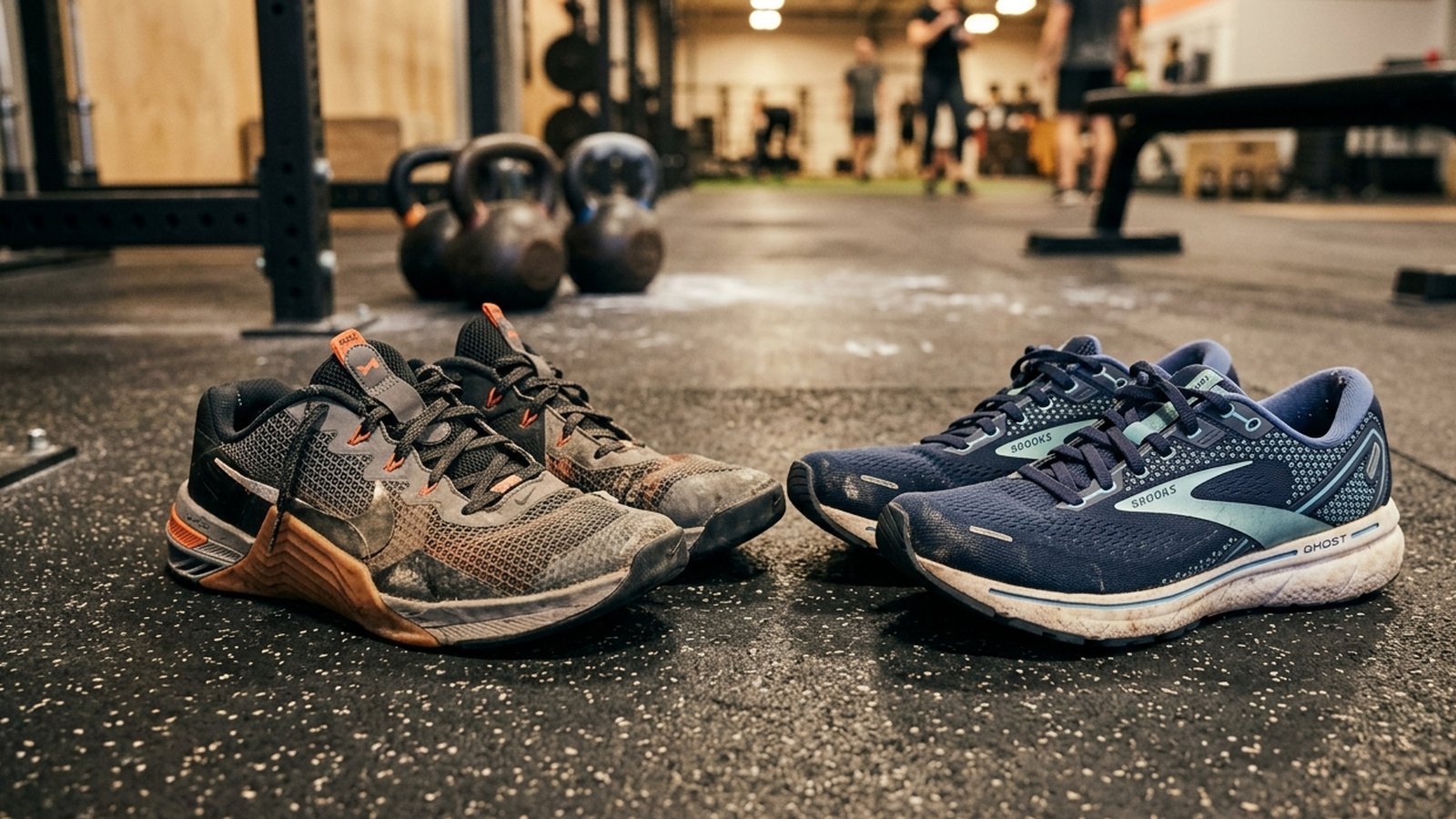
1. Footwear by activity — the most-overlooked decision
Your shoes are the only piece of equipment between you and the floor. Wrong shoes = altered force transfer, reduced performance, increased injury risk. The "one shoe fits everything" approach is exactly what shoe scientists warn against.
| Activity | Shoe type | Why |
|---|---|---|
| Strength training | Flat-sole / cross-trainer | Maximises ground contact & force transfer through the foot |
| Olympic lifts / heavy squats | Lifting shoes (raised heel) | Increases ankle ROM for deeper, safer position |
| HIIT / Circuit / Hyrox | Cross-trainer with stability | Mix of lateral support, modest cushion, durable upper |
| Running / steady cardio | Running shoes | Cushion + heel-to-toe drop tuned for repetitive impact |
| Pilates / Yoga | Bare feet or grip socks | Foot proprioception is part of the practice |
The 2014 systematic review on running-shoe selection in BJSM concluded that "prescriptive" shoe-fitting based on foot type has no evidence of injury reduction — comfort is a better predictor than gait analysis Richards 2009. Pick what feels good and stops feeling tired around the time it's ready to be replaced (~500–800 km / 6–12 months for runners).
2. Fabric science — moisture-wicking actually works
Cotton holds up to 27× its weight in water. Performance synthetics (polyester, nylon, polypropylene) hold less than 5%. That difference matters during a sweaty class — wet cotton becomes heavy, cold, and chafes Akbar-Khanzadeh 2017.
What to look for
- Moisture-wicking synthetics or technical merino for tops and shorts.
- Flat-lock seams reduce friction and chafing during long sessions.
- Fit that allows full ROM — a shirt that pulls during overhead reach will distract you for the whole class.
Merino wool, despite being natural, performs comparably to synthetics for moisture management and has the bonus of resisting odour build-up — useful if you're going from gym to coffee.
3. Fit, support & safety
Fit isn't vanity — it's safety. Loose pant legs catch on gym equipment. Oversized shorts can ride up during squats. Compression shorts under loose shorts solves both problems for most people. Ill-fitting shoes are the leading cause of preventable lower-limb gym injuries in field surveys.
4. Sports bras — non-negotiable
This is one of the most-overlooked equipment decisions in fitness. Without proper support, breast tissue can move up to 14 cm vertically during running, causing pain, ligament damage (Cooper's ligaments don't regenerate), and reduced performance McGhee 2012.
The University of Portsmouth's Research Group in Breast Health is the global authority. Their evidence-based guidance:
- Encapsulation bras (separate cups) outperform compression bras for larger sizes.
- Replace every 6–12 months of regular use as elastic loses tension.
- Get fitted — most women wear the wrong size. The right one feels firm but not painful.
5. Gym hygiene — the research most people would rather not read
A 2014 study cultured surfaces in 27 fitness facilities and found over 70% of equipment tested positive for rhinovirus, with sweat surfaces harbouring 362× more bacteria than a public toilet seat Mukherjee 2014. The good news: most of these microbes are harmless. The actual concerning ones are skin pathogens — Staph aureus, MRSA, fungal infections like ringworm and athlete's foot.
Hygiene basics that actually work
- Wipe equipment before and after use with an antimicrobial wipe — the gym should provide them.
- Use a barrier (towel or mat) between your skin and shared surfaces, especially for floor work.
- Shoes for showers in public locker rooms — fungal pathogens thrive on damp tile.
- Wash hands before touching your face or eating post-workout.
- Cover open cuts with a waterproof bandage before training.
- Don't share towels, bottles, razors — even with people you live with.
- Stay home with active skin infections — and any active fever or contagious illness.
6. Workout laundry science
Sweat plus warm bacteria-friendly fabric = the gym-bag smell most people have given up on. The fix isn't more detergent.
- Wash workout gear within 24 hours — bacteria multiply rapidly in damp fabric.
- Use less detergent, not more — excess detergent traps in fibres, holding odour-causing bacteria.
- Add a half-cup of white vinegar to the rinse cycle to break down odours.
- Air-dry technical fabric when possible — high heat shortens its life and bonds odours in.
- Periodically deep-clean with a sport-specific detergent or a hot soak in oxygen-bleach solution.
7. Etiquette & community
Less science, more common decency, but worth saying:
- Re-rack your weights. Always.
- Don't hover — share equipment between sets.
- Keep your phone away during class — your coach is talking to you.
- Greet new members — you were one once.
- Cheer. Loudly. For everyone.
If you win, we all win.